A CRM diagnostic is a decision-grade assessment that determines whether your CRM produces trustworthy signal for pipeline, forecasting, and performance management—or whether it allows clean-looking data to hide structural failure.
Unlike a CRM health check or audit, a CRM diagnostic tests behavioural integrity: whether CRM updates happen naturally as a byproduct of selling, or appear late through compliance, backfilling, and negotiation.
In one sentence: A CRM diagnostic tells you whether your CRM is load-bearing (trustworthy) or ornamental (credible-looking fiction).
A proper CRM diagnostic measures three things:
Does the CRM reflect what is true about deals early enough to act—or does “signal” appear only after outcomes are already inevitable?
Does the system structure enforce reality through evidence gates and decision logic—or does it allow workarounds that create shadow spreadsheets, “Friday updates,” and compliance theatre?
Can leaders use CRM data to make commitments (board forecast, hiring, capacity planning)—or do meetings become opinion contests because the system cannot be trusted under pressure?
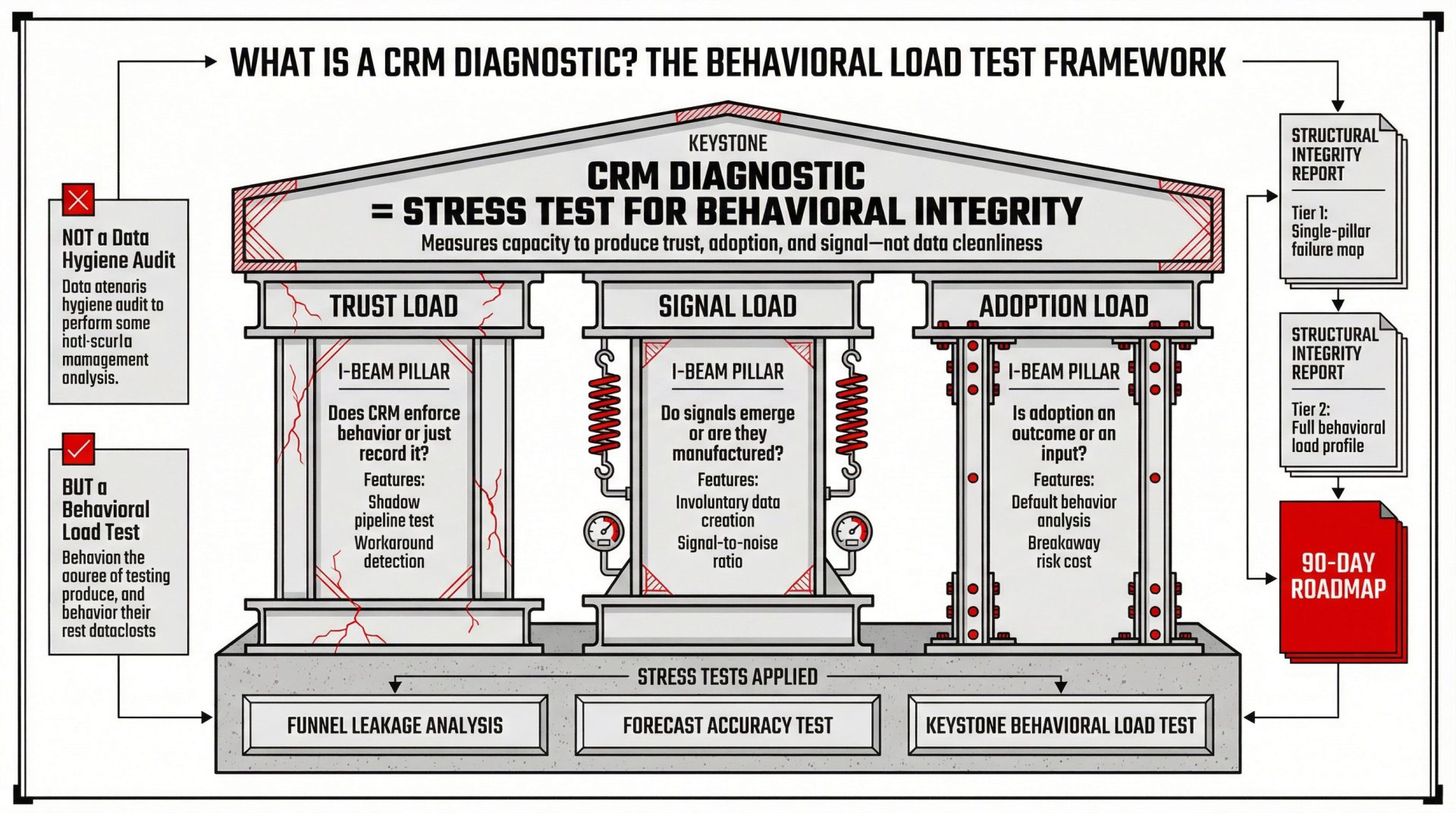
What’s the Difference?
Most teams use these terms interchangeably. They’re not the same.
The core difference:
A health check asks “Is it clean?”
A CRM diagnostic asks “Is it true?”
Run a CRM diagnostic if any of these are true:
If this is you: your CRM problem is not hygiene. It’s integrity.
Outputs
A CRM diagnostic produces clarity you can act on immediately, including:
This is not a dashboard refresh.
This is not an implementation roadmap.
This is not “train reps harder.”
Without Implementation Bias
Sinera is independent by design. We do not implement CRM.
That matters because most CRM assessments are financially biased toward “fixing” and expanding scope.
Sinera’s diagnostics stress-test your CRM using three lenses:
Tests where stage progression allows reality to escape and deals advance without evidence.
Tests whether confidence is earned structurally—or manufactured through narrative shifts.
Tests whether adoption is genuine behaviour under load—or compliance theatre.
Most organisations don’t need “everything.” They need the right diagnostic first.
Focused diagnostics to isolate where your CRM is leaking signal, trust, or forecast integrity.
A defensible verdict on whether your CRM can be trusted for decision-making.
Proceed / Constrain / Stop ruling for executive investment, scale, or risk.
No. Audits are governance/compliance oriented. Diagnostics judge decision integrity and behavioural truth.
No. The diagnostic is designed to start with observable behaviours and system integrity patterns.
No. The diagnostic logic is platform-agnostic. The failure modes are behavioural and structural.
No. Sinera is intentionally independent from implementation. The output is a verdict and decision boundary, not delivery.
